


What if the way you see yourself is the single most powerful force shaping your entire life? Not your circumstances, not your past mistakes, not the opinions of others — but the deeply held beliefs you carry about who you are.
Self-concept is the lens through which you interpret everything, and when that lens is clouded by self-doubt, even good things can feel out of reach. The good news is that your self-concept is not fixed.
It can change, grow, and improve — starting with the words you choose to say to yourself each day. Self-concept affirmations are one of the most direct and effective ways to begin that transformation, one honest and encouraging thought at a time.
What is Self-Concept?

Self-concept is the complete picture you hold of yourself — your beliefs, values, abilities, personality, and the roles you play in the world.
It is not just about how confident you feel on a good day. It is the deeper, more consistent narrative you carry about who you fundamentally are.
Psychologists describe self-concept as having three core elements: self-image (how you see yourself right now), self-esteem (how much you value yourself), and the ideal self (who you want to become).
When these three are aligned and healthy, people tend to make better decisions, build stronger relationships, and handle adversity with greater resilience.
Self-concept begins forming in early childhood and is shaped by family, culture, experiences, and the feedback we receive over time. The encouraging truth is that it is not permanent.
With consistent effort and intentional self-reflection, anyone can reshape how they see themselves and build a foundation that supports a more fulfilling, confident life.
What Are Self-Concept Affirmations?
Self-concept affirmations are deliberate, positive statements designed to reinforce a healthy and accurate sense of who you are. Unlike generic motivational phrases, self-concept affirmations go deeper.
They are not just about feeling good in the moment — they are about rewiring the long-held beliefs that quietly govern your choices, relationships, and sense of possibility.
These affirmations work by directly addressing the internal narrative. When you repeatedly tell yourself, “I am worthy of respect and love,” you are not lying to yourself.
You are countering years of internalized criticism, comparison, and self-doubt with something truer and more constructive.
Self-concept affirmations cover a wide range — from self-worth and confidence to personal growth, mental strength, and success. They can be used by anyone at any stage of life.
Whether you are working through deep-seated insecurities or simply fine-tuning the way you talk to yourself, these affirmations offer a practical and meaningful place to start rebuilding how you see yourself from the inside out.
Benefits of Self-Concept Affirmations
When practiced consistently, self-concept affirmations create real, lasting shifts in how a person thinks, feels, and behaves. The benefits reach far beyond a simple mood boost.
- Stronger sense of identity: Affirmations help you define who you are on your own terms rather than through the lens of other people’s expectations or judgments. Over time, you develop a clearer and more stable understanding of your values, strengths, and purpose.
- Reduced self-doubt: Negative self-talk is often automatic and deeply ingrained. Affirmations interrupt that cycle and replace reflexive self-criticism with a more balanced, encouraging inner dialogue.
- Greater emotional resilience: When your self-concept is strong, setbacks lose some of their power to derail you. You recover faster because your sense of worth is not tied to every outcome or external validation.
- Improved relationships: People who feel secure in who they are show up differently in relationships. They communicate more honestly, set healthier boundaries, and connect without the constant need for reassurance or approval.
- Increased motivation and follow-through: A positive self-concept fuels action. When you genuinely believe you are capable, you are far more likely to take risks, attempt new things, and keep going when progress is slow.
- Better mental health: Consistently affirming your worth and capability has been linked to lower levels of stress, anxiety, and depression. It builds a mental buffer that softens life’s inevitable difficulties.
How Affirmations Improve Self-Concept
The connection between affirmations and self-concept is rooted in how the brain responds to repetition and belief.
When you consistently hear or think something — even if it originated as a statement you were not fully sure of — the brain begins to treat it as familiar and true. This is the principle behind neuroplasticity: the brain changes based on repeated input.
Most negative self-concepts were built the same way. Critical feedback heard repeatedly in childhood, social comparisons made over the years, and failures that were never properly reframed all accumulated into a set of beliefs that felt like facts.
Affirmations work by using the same mechanism — repetition — to build something better in their place.
When you say “I am capable of handling whatever comes my way” each morning, you are not simply reading words off a page. You are creating a new mental reference point.
Each repetition reinforces a neural pathway associated with competence and self-trust. Over time, that pathway becomes the brain’s default route when facing challenges.
For affirmations to genuinely shift self-concept, they need to be specific, believable, and emotionally connected. Vague or overly dramatic statements tend to create internal resistance.
Statements grounded in real qualities and honest intentions feel more accessible — and the brain responds to them more readily.
Consistency matters more than intensity. Five minutes of sincere daily practice will always outperform an occasional burst of enthusiastic repetition.
How to Practice Self-Concept Affirmations
Building an affirmation practice that actually works requires more than reading a list every morning. It takes intention, regularity, and a genuine connection to the words you are using.
- Choose affirmations that resonate. Start with statements that feel believable, even if they push you slightly beyond your comfort zone. Affirmations that feel completely foreign to your current mindset can create resistance rather than progress.
- Set a specific time. Morning is often ideal because it frames the mindset for the rest of the day. Evening works well for reflection and winding down with positive thoughts. Pick a time you can realistically stick to.
- Say them out loud. There is something meaningful about hearing your own voice speak kindly about yourself. Saying affirmations aloud rather than just reading them silently makes a measurable difference in how deeply they land.
- Use a mirror. Standing in front of a mirror while reciting affirmations creates a direct and powerful connection between the words and the self. It can feel uncomfortable at first, which is often a sign that it is working.
- Write them down. Journaling your affirmations adds another layer of intentionality. Writing engages the brain differently from speaking and can deepen the impact of the practice.
- Pair them with your existing routine. Attach your affirmation practice to something you already do daily — morning coffee, brushing your teeth, or a walk. Habit stacking makes new routines easier to sustain.
- Stay patient. Real change in self-concept takes time. Trust the process and measure progress in weeks and months, not days.
How Self-Concept Affirmations Help Kids
Children are forming their self-concept at a rapid pace. Every experience, every interaction, and every word they hear or say about themselves becomes part of the foundation on which their adult identity is built.
This makes childhood one of the most important windows for positive self-concept work.
- They establish healthy self-talk early. Children who learn to speak kindly and honestly to themselves develop an internal voice that supports rather than undermines them. This voice stays with them long after childhood is over.
- They counter the effects of criticism and comparison. Kids are constantly being compared to siblings, classmates, and impossible standards. Affirmations create a counterweight to that pressure by grounding children in their own worth rather than in where they rank.
- They build emotional vocabulary. Affirmations help children name and own positive qualities about themselves. Over time, this expands their ability to understand and express emotions in healthy ways.
- They reduce the impact of bullying. A child with a strong, stable self-concept is more resilient in the face of unkind words. They are less likely to internalize what others say because they already have a clear and positive sense of who they are.
- They support academic confidence. Affirmations focused on learning and effort encourage children to try harder and persist longer. Students who believe they can improve are more likely to do the work required to actually improve.
- They lay the groundwork for healthy adult relationships. Children who grow up with a positive self-concept tend to form more secure attachments and navigate relationships with greater confidence and less anxiety.
- They make emotional regulation easier. When children feel fundamentally okay about who they are, difficult emotions feel less threatening and more manageable. They have a stable base to return to when things get hard.
Self-Concept Affirmations
- I am worthy of every good thing life has to offer.
- My identity is built on strength, honesty, and genuine self-respect.
- I know who I am, and I am genuinely proud of that person.
- I define myself on my own terms, not by what others think or say.
- My self-concept is rooted in truth, not in fear or comparison.
- I am more than my past mistakes, and I refuse to let them define me now.
- I trust the person I am becoming with each honest choice I make.
- My character grows stronger and clearer the more I invest in it.
- I see myself with honesty, kindness, and a great deal of well-earned compassion.
- I am a complete person right now, not a finished product waiting to happen.
- My life is shaped by the values I choose to live by every single day.
- I know my strengths, and I put them to work deliberately and consistently.
- I am secure in who I am, even when the people around me seem uncertain.
- My sense of self does not crumble under pressure or criticism.
- I am growing into the fullest and most honest version of myself every day.
- I carry a quiet confidence in my identity that does not need to announce itself.
- My story is one I am writing with intention, courage, and self-awareness.
- I am both a work in progress and someone genuinely worth knowing right now.
- I accept every part of myself — the polished and the still-developing parts alike.
- My self-image is shaped by compassion, not by my harshest inner critic.
- I choose to see myself clearly rather than through a lens of self-doubt or shame.
- I am a person of real substance, real feeling, and real, lasting value.
- My perspective on myself becomes kinder and more accurate over time.
- I am not defined by a single role, a single failure, or a single difficult season.
- I allow myself to change, grow, and outgrow who I used to be without guilt.
- My self-concept is something I tend carefully, the way you tend something you love.
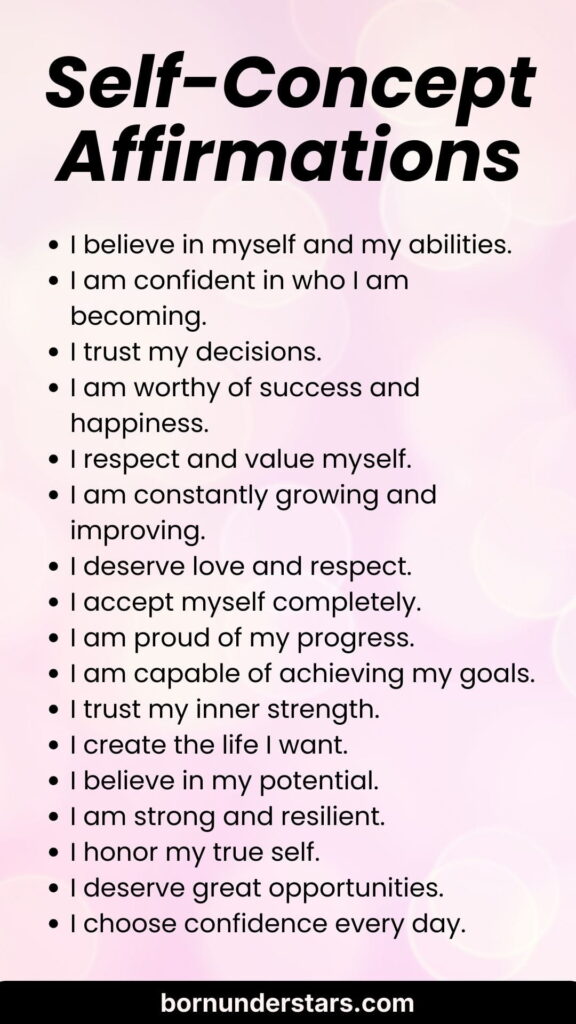
- I hold my own sense of worth steady, even when external circumstances shift.
- I am the expert on my own experience, and I trust that knowledge deeply.
- My confidence comes from knowing myself, not from impressing others.
- I give myself full permission to be exactly who I am, without apology.
- I am deeply acquainted with my values, and I live by them as faithfully as I can.
- My self-awareness helps me grow without becoming self-obsessed.
- I honor myself by choosing relationships and environments that reflect my worth.
- I am not a reflection of other people’s limited ideas of who I should be.
- My foundation of self-knowledge holds firm when life gets difficult.
- I continuously learn about myself and use that knowledge to move forward better.
- I am building a self-concept I can feel genuinely good and peaceful about.
- My identity belongs to me alone, and I protect it with care.
- I speak about myself with the same respect I offer to the people I love most.
- I am exactly the kind of person I have always had the potential to become.
Self-Concept Affirmations for Positive Thinking
- I choose to interpret my life through a lens of possibility rather than limitation.
- My mind is something I actively guide toward hopeful and constructive thoughts.
- I naturally look for what is working rather than fixating on what is not.
- I see challenges as information rather than as proof that I am failing.
- My mindset bends toward growth, even when circumstances push back.
- I release the habit of catastrophizing and replace it with calm, clear thinking.
- I am someone who finds genuine reasons for optimism in ordinary daily moments.
- My thought life is something I take responsibility for and continue to improve.
- I train my mind to return to balance after difficult thoughts pull it off course.
- I believe in good outcomes, not out of naivety but out of earned confidence in myself.
- My perspective acknowledges hard things without being overtaken by them.
- I am becoming someone who thinks more kindly of themselves and others.
- I replace “what if it goes wrong” with “what if it goes exactly right for me.”
- My positive thinking practice grows stronger the more consistently I use it.
- I am wired for hope, and I keep coming back to it no matter what.
- I notice when my thoughts spiral, and I bring them back with patience and skill.
- My self-concept supports positive thinking from the inside out.
- I give more energy to the thoughts that help me than to the ones that hold me back.
- I am becoming more naturally optimistic the more I practice thinking that way.
- My mental environment is something I tend carefully because I know it shapes everything.
Self-Concept Affirmations for Self-Love
- I love who I am, including the parts I am still figuring out.
- My relationship with myself is something I nurture with patience and genuine care.
- I deserve the same warmth and kindness I so readily give to the people I love.
- I choose to stop treating self-love like something I have to earn first.
- My body, mind, and spirit are worthy of consistent and non-negotiable care.
- I love myself enough to set boundaries that protect my peace and energy.
- I am someone worth investing in, and I prove that by how I treat myself daily.
- My self-love does not depend on looking perfect or achieving more.
- I offer myself forgiveness freely because holding grudges against myself helps no one.
- I am whole and worthy of love exactly as I stand in this very moment.
- My heart has room to love others generously and still love myself well.
- I choose to speak to myself with tenderness rather than relentless self-criticism.
- I accept my imperfections as part of what makes me real, interesting, and human.
- My practice of self-love grows more natural the more often I choose it.
- I am learning to like myself first and let love for others flow naturally from that.
- I matter deeply, and I act accordingly in the choices I make every single day.
- My worth existed before I achieved anything and will exist long after.
- I treat myself well, not as a reward for good behavior but because I simply deserve it.
- I am at peace with who I am today while still looking forward to who I am becoming.
- My self-love is strong enough to carry me through even the hardest of days.
Self-Concept Affirmations for Personal Growth
- I am always in the process of becoming a better and more intentional version of myself.
- My growth journey is one I commit to, even when progress is frustratingly slow.
- I measure my growth against who I used to be, not against who someone else is.
- I actively seek out the lessons hidden inside my most difficult experiences.
- My potential is something I have not yet come close to fully reaching or exploring.
- I am not afraid of the person I might become if I keep putting in the honest work.
- I invest time and energy into my personal development without guilt or hesitation.
- My capacity for growth surprises me the more I trust and act on it.
- I step outside my comfort zone regularly because that is where real growth lives.
- I am building new habits and ways of thinking that will serve me for a lifetime.
- My character is shaped more by my choices than by my circumstances.
- I stay curious about myself and never stop asking how I can show up better.
- I outgrow old patterns with patience, practice, and a willingness to be honest.
- My personal growth path is entirely my own, and I walk it with pride.
- I celebrate every small step forward because growth is rarely sudden or dramatic.
- I am someone who actively chooses development over comfort when they conflict.
- My transformation happens quietly, consistently, and with real purpose.
- I let go of who I was when it no longer serves who I am trying to become.
- I am deeply committed to growing in the areas of life that matter most to me.
- My life is one in which I never stop learning, expanding, and becoming more whole.
Self-Concept Affirmations for Mental Strength
- I am mentally stronger than any challenge that has ever stood in my way.
- My resilience is built through real difficulty and honest self-reflection.
- I keep going even when my mind tries to convince me that stopping is easier.
- I have faced hard things before and come out the other side more capable.
- My mental toughness deepens every time I choose effort over avoidance.
- I do not let fear make my decisions — I feel it and move forward anyway.
- I am in control of my thoughts, even when my emotions are running loud and fast.
- My mind stays steady even when circumstances are not.
- I sit with discomfort when I need to because I know it will not last forever.
- I am stronger in my mind than I was a year ago, and I am still growing.
- My mental endurance holds up under pressure and grows through it.
- I face hard conversations, hard decisions, and hard days with real courage.
- I recognize the voice of self-doubt, and I choose not to take directions from it.
- My mental strength is rooted in self-knowledge rather than self-deception.
- I recover from difficult periods faster because I know my own resilience well.
- I choose clarity over panic when things feel uncertain or beyond my control.
- My mind is capable of holding complexity without breaking under the weight.
- I am not fragile — I am tested, adaptive, and fundamentally capable of surviving hard things.
- I build mental strength the same way I build any other skill: through daily practice.
- My psychological foundation is strong enough to support the life I am building.
Morning Self-Concept Affirmations
- I wake up today with a clear and confident sense of who I am.
- Every morning brings a fresh opportunity to show up as my best self.
- I begin this day grounded in my values and sure of my own worth.
- I set the tone for my day by choosing thoughts that support and encourage me.
- My mindset is something I choose with intention from the moment I open my eyes.
- I face today as someone who is prepared, capable, and genuinely ready.
- I carry my self-concept into this morning like a steady and reliable compass.
- My purpose gives this day meaning before it has even fully begun.
- I greet this morning knowing I bring something real and valuable to it.
- I am exactly the person today needs me to be, and I show up fully.
- My self-image starts strong in the morning and holds through the day.
- I use this morning to remind myself of everything I am and everything I am building.
- I do not drift into the day — I enter it with direction, energy, and self-assurance.
- My routine begins with honest and nourishing thoughts about who I am.
- I start each morning as someone who likes, respects, and believes in themselves.
- I choose a morning mindset that feeds my confidence rather than my doubts.
- My self-concept wakes up with me and remains intact throughout the day.
- I am grateful to have another morning to live in alignment with my truest self.
- I remind myself each morning that I am enough — before I do a single thing.
- My morning practice of self-affirmation sets everything else up right.
Night-Time Self-Concept Affirmations
- I close this day proud of who I was and how I showed up when it counted.
- My self-concept stays intact even after a difficult or imperfect day.
- I release the day’s tensions and return to the steady knowledge of my own worth.
- I forgive myself for anything that did not go as I hoped and move on with care.
- My mind settles gently at night with kind and honest thoughts.
- I reflect on today with compassion rather than a harsh and unforgiving lens.
- I am proud of every moment I chose to be true to myself today.
- My sense of self is strong enough to survive a bad day and wake up intact.
- I carried my values with me today, and that is always something worth noting.
- I rest tonight knowing that my worth is unchanged by today’s wins or losses.
- My peace comes from knowing exactly who I am and being okay with it.
- I let go of comparisons, criticisms, and self-judgment as I prepare to sleep.
- I treated myself fairly today, and tomorrow I will do the same again.
- My self-image is something I protect by ending each day with gentleness and perspective.
- I am at peace with the person who is getting into bed tonight.
- I sleep well because I know that my self-worth does not reset overnight.
- My quiet and steady confidence follows me even into my rest.
- I am grateful for the ways I grew, tried, and showed up honestly today.
- I give myself credit for the effort I put in, even when the results were not perfect.
- My self-concept is built night by night through rest, reflection, and real honesty.
Self-Concept Affirmations for Teens
- I am figuring out who I am, and that process deserves patience, not pressure.
- My identity is something I get to define for myself, not something assigned to me by others.
- I do not need to have everything figured out to have a solid sense of who I am.
- I am more than the version of me that fits neatly into someone else’s category.
- My self-concept grows stronger the more I listen to my own voice first.
- I am allowed to change my mind about myself as I learn and experience more.
- I choose not to let social media define my worth or dictate how I see myself.
- My confidence comes from within, not from likes, followers, or approval.
- I am learning to trust my instincts even when peer pressure pushes in another direction.
- I know who I am well enough to recognize when someone is trying to change that.
- My future is full of real possibilities that I have not even begun to tap yet.
- I am not the sum of my awkward moments, hard phases, or embarrassing memories.
- I value my individuality because fitting in has never led anyone to something great.
- My self-worth cannot be permanently damaged by any grade, rejection, or harsh comment.
- I am building the foundation of who I will be for the rest of my life right now.
- I am allowed to be a work in progress while still feeling good about who I am today.
- My resilience is strong enough to handle the particular pressures of being a teen.
- I take feedback that helps me grow and release the criticism that only tears me down.
- I am standing in one of the most formative seasons of my life, and I am handling it.
- My story is just getting started, and I like where the early chapters are heading.
Self-Concept Affirmations for Students
- I am a capable and dedicated learner who grows with every challenge I face.
- My mind is built for curiosity, critical thinking, and continuous improvement.
- I show up to learn every day, and that consistency is something to be proud of.
- I am not defined by a test score, a grade, or a subject I find difficult.
- My work ethic serves me well beyond any single assignment or exam.
- I ask questions because understanding matters more to me than appearing to already know.
- I am developing skills right now that will pay off in ways I cannot yet fully see.
- My student identity is rooted in effort, not in the illusion of effortless talent.
- I handle academic pressure without letting it shake my belief in my own capability.
- I am the kind of student who keeps trying even when the material feels overwhelming.
- My learning journey is unique to me, and I respect the pace at which I grow.
- I celebrate progress in my understanding, not just the moments when I get it right.
- I am building intellectual confidence with every paper, project, and exam I complete.
- My student life prepares me for something meaningful and worth working toward.
- I manage my time and responsibilities well because I take my future seriously.
- I am smart in ways that tests do not always measure, and I hold onto that firmly.
- My focus sharpens when I remember why I am putting in the work.
- I believe in my ability to understand difficult concepts when I give them enough time.
- I am not competing with my classmates — I am collaborating with them and competing with yesterday’s version of myself.
- My student mindset turns struggle into skill and confusion into clarity.
Self-Concept Affirmations for Overcoming Self-Doubt
- I no longer let self-doubt have the final word about who I am or what I can do.
- My confidence is rebuilt one small act of courage at a time.
- I question my doubts more rigorously than I question my abilities.
- I have evidence that I can do hard things, and I choose to focus on that evidence.
- My voice — my own — is the one I am choosing to trust more than my inner critic.
- I act despite self-doubt because waiting for certainty means waiting forever.
- I catch myself in moments of self-doubt and ask if the thought is actually true.
- My track record of survival, adaptation, and real success is something doubt often ignores.
- I refuse to let fear of getting it wrong stop me from getting it started.
- I am more capable than my self-doubt has ever been willing to admit.
- My relationship with uncertainty is something I am actively making more comfortable.
- I separate facts from feelings when doubt tries to convince me I am not good enough.
- I have outgrown doubt before, and I will do it again as many times as it takes.
- My self-belief is something I rebuild deliberately after every setback that shakes it.
- I choose to be on my own side even on the days when self-doubt is loud and persistent.
- I replace “I am not sure I can” with “I am willing to find out if I can.”
- My courage shows up most clearly in the moments I almost talk myself out of trying.
- I take one step forward whenever doubt tells me to stand still and stay safe.
- I know the difference between genuine caution and self-doubt dressed up as logic.
- My life is too meaningful to be left in the hands of a voice that never believed in me.
Self-Concept Affirmations for Success Mindset
- I am fully capable of creating the kind of success that is genuinely meaningful to me.
- My definition of success is something I chose deliberately and am actively working toward.
- I take consistent, focused action because I know that is what success is actually built from.
- I believe in my goals enough to show up for them even when motivation is low.
- My success mindset is grounded in discipline, clarity, and real self-belief.
- I learn from every setback and use that learning to come back sharper and more prepared.
- I am building something lasting, and I trust the foundation I am laying right now.
- My vision for my future is clear enough to keep me moving on hard and uncertain days.
- I define success broadly — as growth, contribution, and alignment, not just achievement.
- I am someone who finishes what they start because follow-through is part of who I am.
- My work ethic creates results, and my mindset sustains them over time.
- I do not wait for the perfect moment — I make the current moment work for me.
- I am worthy of success, and I do not feel guilty for wanting it or pursuing it.
- My self-concept is aligned with the goals I am working toward every single day.
- I take full ownership of my outcomes because I know my choices shape my results.
- I am getting closer to my goals with every decision I make in alignment with them.
- My long-game mindset does not get derailed by slow progress or temporary plateaus.
- I surround myself with people, ideas, and environments that support my growth.
- I am building success from the inside out, starting with how I see and value myself.
- My momentum is building quietly and powerfully beneath everything I am doing now.
Self-Concept Affirmations for Self-Worth
- I am worthy not because of what I produce but because of who I inherently am.
- My worth existed before any achievement and will remain after every failure.
- I do not negotiate my self-worth in exchange for approval or belonging.
- I am enough — not almost enough, not potentially enough — genuinely enough right now.
- My value as a human being cannot be increased or reduced by external circumstances.
- I stop apologizing for taking up space, having needs, and holding firm opinions.
- I treat my own needs as legitimate and worth addressing without guilt or hesitation.
- My self-worth is something I refuse to hand over to comparison, criticism, or rejection.
- I am worthy of relationships, opportunities, and experiences that reflect my actual value.
- I hold my head up not because life is easy but because I know what I am worth.
- My core belief in my own value is something I protect and return to often.
- I release the habit of measuring my worth by how useful, successful, or needed I am.
- I am valuable in my quietest, most unproductive, and most ordinary moments, too.
- My self-worth is rooted in character and integrity, not performance or praise.
- I know I am worthy of kindness even on the days I do not feel very impressive.
- I stop shrinking my presence to make others more comfortable with who I am.
- My worthiness does not require an audience or outside confirmation.
- I honor my worth by choosing situations and relationships that reflect it to me.
- I am not less worthy because someone chose not to see my value — that is about them.
- My self-worth is something I am done undermining, qualifying, or putting up for debate.
Self-Concept Affirmations for Motivation
- I am driven by a sense of purpose that keeps me moving even when energy is low.
- My motivation comes from within rather than from outside pressure alone.
- I connect to my reason for working hard whenever the surface-level drive runs dry.
- I show up on unmotivated days because I know discipline carries what feelings cannot.
- My momentum builds the moment I take even the smallest meaningful action.
- I am someone who moves toward goals rather than waiting for perfect conditions.
- I remind myself of my progress when the distance left feels too great to cover.
- My inner drive is connected to values deeper than mood or convenience.
- I do the work today knowing that my future self will be genuinely grateful for it.
- I am more motivated when I focus on who I am becoming rather than how far I have to go.
- My work ethic is something I am proud of, and it pushes me forward on even the flattest days.
- I set goals that excite me enough to get out of my own way and actually pursue them.
- I return to my “why” whenever the “how” starts to feel too overwhelming and unclear.
- My drive does not burn out because it is fueled by something that genuinely matters.
- I permit myself to rest without guilt because rest is part of sustainable motivation.
- I am not waiting to feel motivated — I act and let the motivation follow behind me.
- My daily commitment to showing up builds a life I am truly proud of.
- I celebrate small wins because acknowledging progress keeps motivation alive.
- I am the kind of person who finds a way to keep going because giving up costs too much.
- My sense of purpose is strong enough to outlast any temporary dip in motivation.
How to Practice Self-Concept Affirmations Daily
Building a sustainable daily affirmation practice is less about doing more and more and more about doing it consistently. Here is how to make it a natural and meaningful part of your routine.
- Start with a personal audit. Before choosing affirmations, spend a few quiet minutes thinking about how you currently see yourself. What do you say about yourself when things go wrong? Where does your self-talk turn the harshest? Your daily affirmations will be most effective when they directly address the specific areas where your self-concept needs the most support.
- Keep your list focused. Choose three to five affirmations to work with at a time. A long list can feel like a chore. A focused list feels like a conversation you are having with yourself — one that builds depth over time.
- Say them during transition moments. Morning is the most commonly recommended time, and for good reason. It anchors your mindset before the demands of the day take hold. But affirmations said during transitions — before a meeting, after a difficult interaction, during a commute — are just as powerful.
- Write them in a dedicated journal. Handwriting your affirmations each morning or evening engages the brain more deeply than simply reading them. The physical act of writing creates a stronger neural connection to the content.
- Create visual reminders. Post affirmations on your bathroom mirror, your desk, the lock screen of your phone, or a sticky note on your laptop. Repeated visual contact reinforces the message throughout the day without requiring dedicated sessions.
- Record yourself saying them. Play the recording back during walks, commutes, or quiet moments. Hearing your own voice affirm your worth is one of the most direct ways to make these statements feel real and personal.
- Practice with emotion. Simply reading words mechanically has a limited effect. When you say your affirmations, pause and connect with the feeling behind each one. Even a moment of genuine feeling amplifies the impact significantly.
- Review and rotate regularly. As your self-concept shifts and grows, your affirmations should shift with it. Review your list monthly, retire the ones that feel fully integrated, and introduce new ones that address your current edge of growth.
- Be patient with the process. Changing a self-concept that has been building for years is not a two-week project. Commit to the practice for at least sixty to ninety days before evaluating how it is working. The changes are often subtle and cumulative before they become obvious.
- Combine affirmations with action. Affirmations are most effective when paired with behaviors that reinforce them. If you are affirming that you are disciplined, take one disciplined action that same day. The combination of word and deed accelerates the rewiring process considerably.
Tips to Make Self-Concept Affirmations More Effective
Affirmations work better with a little strategy behind them. Here are practical ways to get more from your daily practice.
- Use the present tense. State affirmations as current facts rather than future hopes. “I am confident” lands differently in the brain than “I will be confident someday.” The present tense creates immediacy and makes the statement easier to internalize.
- Make them specific to your life. Generic affirmations have some value, but statements tailored to your specific challenges and goals cut deeper. “I handle creative criticism with openness and confidence” is far more targeted than “I am strong.”
- Pair them with evidence. After saying an affirmation, follow it with a brief real-life example that supports it. “I am resilient — I handled last year’s setback and came out better for it.” Evidence anchors the affirmation in reality rather than wishful thinking.
- Address resistance honestly. If a particular affirmation consistently triggers disbelief, start with a bridging statement. “I am open to believing that I am worthy” is more accessible than a statement that feels completely false, and it still moves you in the right direction.
- Use body language intentionally. Stand tall, look forward, and breathe deeply when saying affirmations. Physical posture communicates to your nervous system and makes the words feel more congruent and believable.
- Share your practice with accountability. Telling someone you trust about your affirmation practice creates gentle accountability. It also normalizes the habit and makes it more likely you will stick with it past the initial enthusiasm.
- Do not force positivity. Affirmations are not about pretending difficult things are not happening. Acknowledge hard realities and then return to the affirmation as a choice rather than a denial of truth.
Conclusion
Your self-concept is not carved in stone. It is a living, evolving picture of who you are — one that changes every time you choose a kinder, truer thought about yourself. Self-concept affirmations are not magic words. They are daily acts of commitment to seeing yourself clearly and treating yourself well. Start small, stay consistent, and trust that every honest, encouraging statement you choose brings you measurably closer to the confidence you deserve.